Thanks to Mrs. Hayes, who won a Clif Grant, the 7/8 team will be able to meet with Tanya Lee Stone. In preparation for this visit, students will read sections from Almost Astronots and The Good, The Bad and the Barbie. These books reflect upon the impact of society on the identify of women and their roles/opportunities in society.
Thursday, April 14, 2011
Bug Life
Each year, I challenge students to reflect on the bug life problem. The problems runs as follows:
A bug lives on a number line. On its birthday, it must toss a coin and move positive one for heads or negative one for tails. The bug will die when it gets to either -2 or +2. How long will the bug live?
This is a classic problem in binomial probability so the students have many different points of entry. Some students play the game by hand ten or more times and find the average lifespan. This is generally around 3.6 years. These students also notice that the bug only dies on even turns.
Other students enter the problem through the use of Pascals Triangle. This allows students to calculate the number of pathways that would allow a bug to live and to compare this to the total possibilities. The students generally discover that the bug's liklihood of survival drops, by about half, every two turns.
Some students accept the challenge to write a computer program to run. I provide all of the students with TI Basic programs and Logo programs to help the students consider this problem. The programs are saved for the students on the school network. This year, however, was the first year that a student used a Scratch program.
The students learn Scratch through the Tech Savy kids program, run my Mrs. Hayes afterschool on Tuesdays. Here is a screen shot of the program and the code!
Hacker Trail Photos
Students experienced westward expansion in social studies class through a guided simulation, The Hacker Trail. In the simulation, students must select specific goods to bring with them on their westward migration and then students are given choices to make along the way. The outcome of those choices may be determined by chance, through the use of a coin toss, coin throw or a dice roll. Some students have formed alliances, others have attacked one another and some have branched out on their own.

In order to more fully embrace the experience, students dressed in western regalia, including wide brimmed hats, collared shirts, flannel, jeans and boots.
Wednesday, April 13, 2011
Acid Base Model Lab
Methods
In class today, our teacher constructed a chemical gun for us. The gun used 2 ml of 1 M HCl with 8 ml of tap water to produce a 10 ml solution with a pH of 2.76. We measured the ph using a Vernier pH probe, CBL2 and a graphing calculator.
These materials were placed inside a plastic test tube. The water solution was covered with vegetable oil, which floated on top of the water because it was less dense. The oil also did not react with either the acid or the baking soda that was placed on top of it.
During the next step, our teacher placed 6 grams of baking soda on top of the oil layer so that the baking soda would not react with the acid.
Finally, a rubber stopper was placed inside the test tube. My teacher then shook the test tube vigorously and I could hear and see that a gas was being produced. When my teacher released his finger over the top of the rubber stopper, it flew away.
Another student videoed the rubber stopper flying through the air so that we could measure the speed of the rubber stopper using frame by fame video analysis with Tracker Pro.
In order to analyse the video, we had to first change the file extension so that tracker would open the video. Then, we opened the video and placed a ruler inside of it. We could tell that the video was distorted by changes in perspective, which made the video difficult to accurately measure.
Nevertheless, we then proceeded to add a point mass and we marked three frames of movement of the rubber stopper.
Data
Start | End | |
pH of water solution | 2.76 | 6.4 |
Chemical Reaction
Na (CO3)2 + HCl -> NaCl + H2O + CO2
Conclusions
In this lab, we observed an acid base reaction that changed an acidic solution into a less acidic solution by releasing hydrogen gas. We know this happened because the pH changed from 2.76 to 6.7, which is a change on the order of 10,000 free hydrogens (H+) (for every hydroxide (OH-)) were released from the solution. This also proves that we formed water.
We also know we formed a gas, which we think is CO2 because we saw the bubbles and the pressure caused the rubber stopper to fly through the room.
We know we formed salt because we boiled a sample of water from the heterogenous mixture that resulted from the experiment. When the liquid was removed, the beaker was covered with salt crystals.
The carbon dioxide gas expanded quickly and built pressure inside the test tube, which is why the rubber stopper flew away. Eventually, the forces holding the stopper in place were less than the forces of the gas wanted to expand as more and more gas compressed the existing gas.
This labs shows that a chemical equation can be used to produce mechanical forces as a result of the properties of gas. We also illustrated that differences in density and solubility can be used to prevent chemical reactions. This is like a cell membrane blocking the free movement of materials inside our outside of a cell.
We also noticed that there was extra baking soda on the bottom of the test tube. We realized that the acid must have been the limited reagent because we ran out of it first, which allowed for left over baking soda.
Tuesday, April 12, 2011
Table design
We are trying to design a table that will be stable for holding waste, easy to store( folding), easy to clean and attractive. We would like the table to be able to accommodate two trays and the waste buckets. Our model table was wide enough at 27.5". Similarly, our model table was long enough at 70".
We would like to either build a table or modify a table that we can purchase. Students and their parents are encouraged to work together on this project.


Two students, partnered from both the 5/6 and the 7/8 team worked on developing a 3-D rendering of the school for our presentation to Laurie D. from the Vermont Compost Association tomorrow. The students elected to work on the project and the teams re-arranged the students' schedules so that they would have close to three hours (from both science and math classes) to work on the project today.
Their model includes not only the original 3-d table, which is inside the cafeteria, but it contains a mock-up of the future garden. The use of 3-d modeling software allows us to consider different systems and helps us to identify problems in our current systems.

- Posted using BlogPress from my iPhone
We would like to either build a table or modify a table that we can purchase. Students and their parents are encouraged to work together on this project.


- Posted using BlogPress from my iPhone
Monday, April 11, 2011
2011 VT State Chess Tournament Press Release
Among the nearly 200 students, from across Vermont, that gatherer for the 24th Annual Chess Championship were eight students from Grand Isle County. Evan Pidgeon, South Hero, competed in the kingergarten competition. C.C. Hinds, Grand Isle, competed in the first grade. Quinn Pidgeon and Leo Chatkin, both of South Hero, competed in the third grade. Zac Hinds, of Grand Isle, competed in fourth grade. Herbert Dufree, Grand Isle, competed in sixth grade. Jack Clain, South Hero, finished fourth in the 7/8 division and Eli Hinds, of Grand Isle, finished second in the 7/8 division. Eli’s play places him in consideration for a birth at nationals, which is guaranteed to the Vermont middle and high school champions. Fortunately for Eli, he has another year at this level of play.
Saturday, April 9, 2011
Integrated Arts Academy Visit
Two students and I met with Ryan Fitzgerald this past Friday to learn about how composting is completed at the Integrated Arts Academy (IAA). The IAA has a little more than 200 students from across the City of Burlington. The IAA shared very little with Stowe's program.
IAA's was funded through a district wide initiative and a contract with Rauthier waste disposal and Chittenden solid waste. This contract provides the school with five large compost totes, which are collected twice weekly and hauled to the Interval. Similarly, this contract provides biobags, buckets, and bins for the storage and movement of waste.
Ryan stepped in last spring to help the IAA realize the benefits of the existing contract. He set-up a small composting group, arranged for school training and planned the system, which included parent volunteers.
This system operates in a permanent cafeteria and uses a parent designed and constructed table to help the students sort waste into five categories: liquid waste (which is composted at Intervale), recyclable waste (this school gets milk in plastic containers), bottle tops (these are sent to a company like Terra Cycle that converts the tops to bottles), trash waste and compost. (illustrated to the left)
Behind each station is a student with tongs and an apron. These students assist in the act of sorting waste and use to tongs to correct any mistakes.
This is possible, in part, because the students have
a half hour for lunch, which allows them plenty of time to eat and to then help. Additionally, children who helped out receive a temporary tattoo as a reward.
(sign up sheet is listed to the left)
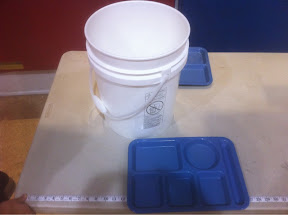
This image illustrates the content of the liquid waste bucket. It contains mostly chocolate milk and a frozen dessert that came in a recyclable container. The students were expected to peel the foil off of these containers before recycling the container and before throwing the foil away.
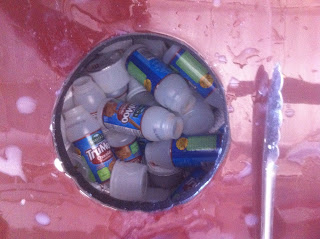
This illustrates the recycling bin during this lunch, which is quite full. Students receive their milk in these plastic containers.
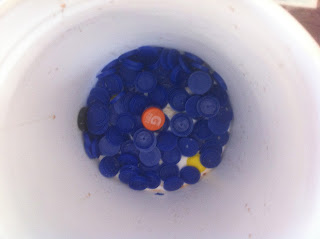
This illustrates the bottle tops. These are saved and mailed in prepared packages to the company that recycles them.
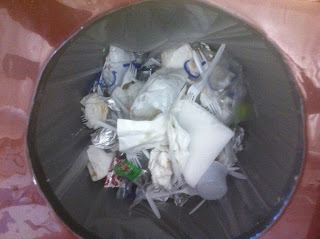
I was surprised that the cafeteria uses plastic forks and knives, which appeared to be the bulk of the trash.

Likewise, biodegradable trays appeared to be the bulk of the compost.
Before we left, Ryan engaged us in a skit and a game. He explained that students from BHS had performed a recycling play when composting started in November. He mentioned several memorable characters from the play, such as the Wicked Witch of the Waste!
The skit that was performed by the students began with the students role playing a typical lunch. One of the students was the teacher and others students played naughty students. The students then started to dispose of their waste when a trash monster appeared and dumped all of the waste on the floor. The heros challenged one another to pick up the waste properly and the winner would be finished first. The students then broke into two relay teams where each leg was allowed to pick up two pieces of waste and to properly sort it.
Overall, the quality of student involvement was superb. Likewise, the integration of drama was integral to the student understanding of the sorting process. I believe this would be an essential component of any training we would do with the students. The use of plastic bottles for milk should be explored because our current waste is largely milk cartons, which are not recyclable nor are then compostable.
Our next step is to develop a plan to present to Laurie Decesere, who will be visiting this coming Friday. She is the regional trainer for the Vermont Compost Association. I hope that she will be able to troubleshoot our plan when she visits and help us anticipate problems we did not recognize.
We plan to have a proposal to present to Mrs. Lemieux, Chef Bob and Cecile and Mr. Berard on the Wednesday after April recess.
Ryan stepped in last spring to help the IAA realize the benefits of the existing contract. He set-up a small composting group, arranged for school training and planned the system, which included parent volunteers.
Behind each station is a student with tongs and an apron. These students assist in the act of sorting waste and use to tongs to correct any mistakes.This is possible, in part, because the students have
a half hour for lunch, which allows them plenty of time to eat and to then help. Additionally, children who helped out receive a temporary tattoo as a reward.
(sign up sheet is listed to the left)
This image illustrates the content of the liquid waste bucket. It contains mostly chocolate milk and a frozen dessert that came in a recyclable container. The students were expected to peel the foil off of these containers before recycling the container and before throwing the foil away.
This illustrates the recycling bin during this lunch, which is quite full. Students receive their milk in these plastic containers.
This illustrates the bottle tops. These are saved and mailed in prepared packages to the company that recycles them.
I was surprised that the cafeteria uses plastic forks and knives, which appeared to be the bulk of the trash.
Likewise, biodegradable trays appeared to be the bulk of the compost.
Before we left, Ryan engaged us in a skit and a game. He explained that students from BHS had performed a recycling play when composting started in November. He mentioned several memorable characters from the play, such as the Wicked Witch of the Waste!
The skit that was performed by the students began with the students role playing a typical lunch. One of the students was the teacher and others students played naughty students. The students then started to dispose of their waste when a trash monster appeared and dumped all of the waste on the floor. The heros challenged one another to pick up the waste properly and the winner would be finished first. The students then broke into two relay teams where each leg was allowed to pick up two pieces of waste and to properly sort it.
Overall, the quality of student involvement was superb. Likewise, the integration of drama was integral to the student understanding of the sorting process. I believe this would be an essential component of any training we would do with the students. The use of plastic bottles for milk should be explored because our current waste is largely milk cartons, which are not recyclable nor are then compostable.
Our next step is to develop a plan to present to Laurie Decesere, who will be visiting this coming Friday. She is the regional trainer for the Vermont Compost Association. I hope that she will be able to troubleshoot our plan when she visits and help us anticipate problems we did not recognize.
We plan to have a proposal to present to Mrs. Lemieux, Chef Bob and Cecile and Mr. Berard on the Wednesday after April recess.
Subscribe to:
Posts (Atom)